Experimental Modern and Quantum Physics for Do-It-Yourself Science Enthusiasts 

Facebook Flickr LinkedIn YouTube RSS
magnify
formats

Perkin Elmer C30902E SPADs on eBay for $91 (Unrelated to Authors)

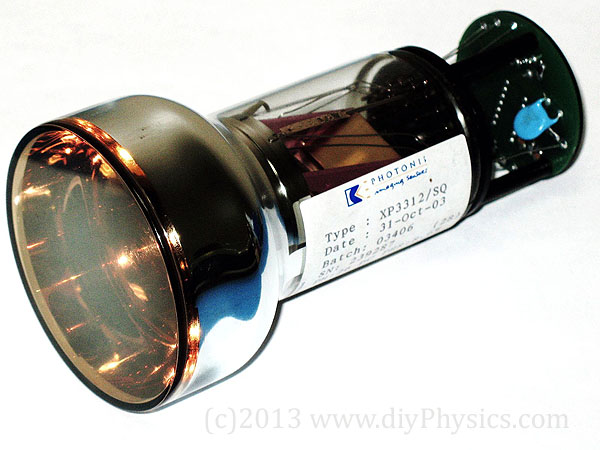
Perkin Elmer Excelitas single photon avalanche photodiodes on eBay  www.diyPhysics.comSomeone (I don’t know the seller) is selling brand new Perkin Elmer C30902E Silicon Avalanche Photodiodes on eBay.  Auction number:  200747161278.

These are NOT chilled by a thermoelectric cooler, so their internal noise may be too large for experiments with entangled photons unless you rig some sort of external Peltier element to keep them chilled.  However, if you are developing a SPCM, using $91 SPADs during debugging is a lot better than frying $1,000 TE-cooled SPADs.

Read more…

 
 Share on Facebook Share on Twitter Share on Reddit Share on LinkedIn
1 Comment  comments 
formats

Is That Girl With the Green Hair Talking About Quantum Physics?

David and Shanni Prutchi at Barnes&Noble book signing.  Marlton, NJ April 18, 2012We had a very nice book presentation and discussion last night at Barnes & Noble in Marlton, NJ.  Quite a few curious shoppers stopped by while Shanni presented a lecture on diy Quantum Physics.  Thanks to our very few, but very loyal fans  :) Read more…

 
 Share on Facebook Share on Twitter Share on Reddit Share on LinkedIn
No Comments  comments 
formats

Lecture on “Do It Yourself Quantum Physics” and Book Signing at Barnes & Noble this Tuesday

We have been invited by Barnes & Noble in Marlton Circle to their Educator’s Night to lecture on “Do It Yourself Quantum Physics”:

Educator Event Teachers are invited to meet authors David Prutchi and Shanni Prutchi for a “Do-It-Yourself Quantum Physics” night! Book Talks, thank-you bags, fun and door prizes also. CEUs available for attendance from 6:30 to 8:30 pm. Call 856.596.6881 to register.
Tuesday April 17, 2012 6:30 PM Marlton 200 West Route 70, Marlton, NJ 08053, 856-596-7058
We will be lecturing at 7:30pm.  Our lecture at 7:30pm and meet & greet are open to the public.  We would love to see you there!
 
 Share on Facebook Share on Twitter Share on Reddit Share on LinkedIn
No Comments  comments 
formats

Telling Apart 365 nm from 395 nm Ultraviolet LEDs and Flashlights

Comparison of fluorescence produced on Canadian bills by 365nm and 390nm UV LEDs. David Prutchi, Ph.D.Today I received an UltraFire WF-502B UV flashlight advertised as emitting at 365 nm.  I was wondering how to tell if it really does, especially since vendors commonly list it as emitting 365-400 nm.

Well, I was in Canada last week, and had $25 Canadian left over in my wallet, so I tried this flashlight and compared it to the fluorescence produced by an Inova X5MT-UVT 400 nm flashlight.  Much to my surprise, the 365 nm UltraFire caused fluorescence that did not show up at all under the Inova 395 nm flashlight. Read more…

 
 Share on Facebook Share on Twitter Share on Reddit Share on LinkedIn
1 Comment  comments 
formats

No Joke: Science Is A Laughing Matter – NPR’s Science Friday April 1st Edition

 h bar joke.  www.diyPhysics.com

Yesterday, Friday, March 30th, 2012, NPR’s Science Friday had its yearly April 1st “No Joke: Science Is A Laughing Matter” program.  Want to hear a joke about sodium hypobromite? NaBrO! Can science be the butt of a good joke? Ira Flatow and guests test the hypothesis in an annual April Fools’ joke-a-thon. They share the best gags in the business. Sidesplitting or groan-worthy? You decide.

Program announcement in NPR’s Archive:

 http://www.sciencefriday.com/program/archives/201203301

Download mp3 of the show: http://www.podtrac.com/pts/redirect.mp3/traffic.libsyn.com/sciencefriday/scifri201203301.mp3


 Share on Facebook Share on Twitter Share on Reddit Share on LinkedIn
No Comments  comments 
formats

Testing Electronic Goldmine’s “Giant Super Sensitive Geiger Muller Tube MC6″

Russian-made MC6 Geiger Muller Tube evaluated by David Prutchi PhD www.diyPhysics.com

I purchased two “Giant Super Sensitive MC6″ GM tubes from Electronic Goldmine (Item Number : G18717, Unit Price: $89.95).  These are Russian-made new-old-stock model MC6.  They are 10.25″ long x 0.9″ diameter.  I compared the sensitivity of these tubes to the other GM tubes that I use with my CDV700 Pro Geiger Counter. Read more…

 
 Share on Facebook Share on Twitter Share on Reddit Share on LinkedIn
3 Comments  comments 
formats

Tom Van Baak’s Family-Friendly Relativistic Time-Dilation Experiment

Tom Van Baak and his family-friendly relativistic time-dilation experiment

Image Credit: Tom Van Baak, Leapsecond.com

I was going through my e-mails for some information on atomic frequency standards, when I came across an e-mail that I had sent to Tom Van Baak in 2007 congratulating him for his family-friendly time dilation experiment.  If you are not familiar with his work,  I heartily recommend that you explore his precision-time-keeping webpage at LeapSecond.com. Read more…

 
 Share on Facebook Share on Twitter Share on Reddit Share on LinkedIn
2 Comments  comments 
formats

d.i.y. Alpha-Particle Rutherford Scattering Experiment – Supplementary Pictures

diy Alpha-particle Rutherford scattering device by David and Shanni Prutchi www.diyPhysics.com

The book’s Figures 70 and 71 show our d.i.y. version of a popular apparatus to measure alpha particle scattering.  The figure above shows additional views to help you build your own.  The apparatus allows you to demonstrate alpha particle scattering discovered by Ernest Rutherford in 1908.  Fundamental to the discovery of the atom’s structure, the experiment demonstrates that the charge of the atomic nucleus is concentrated at the center of the atom. Read more…

 
 Share on Facebook Share on Twitter Share on Reddit Share on LinkedIn
No Comments  comments 
formats

Connecting to Surplus Scionix Miniature Scintillation Probes

Scionix miniature photomultiplier scintillation probe David Prutchi PhD www.diyPhysics.com

Lemo connector on Scionix miniature photomultiplier scintillation probe David Prutchi PhD www.diyPhysics.com

Scionix in The Netherlands has taken advantage of the recent development of miniature mesh-type dynode photomultiplier tubes to construct small-diameter scintillation probes.  Scionix’s miniature probes incorporate one of those PMTs, a NaI(Tl) scintillation crystal, and a built-in dynode voltage divider.  Connection to the probe is made through a miniature high-voltage locking coaxial connector.  Finding a mating connector is the main problem faced by enthusiasts who find these probes in the surplus market. Read more…

 
 Share on Facebook Share on Twitter Share on Reddit Share on LinkedIn
2 Comments  comments 
formats

Simple d.i.y. Bias-T for Scintillation Probes with Single Connector

diy Signal/High-Voltage Splitter for Scintillation Probe with Single Connector David Prutchi www.diyphysics.comMany surplus scintillation probes have a single connector through which the PMT is fed with high voltage and the anode signal is output.  However, this may require an external “Bias-T” (a high voltage / signal splitter) to connect the probe to a high-voltage power supply that is separate from the PMT amplifier/processor. Read more…

 
 Share on Facebook Share on Twitter Share on Reddit Share on LinkedIn
No Comments  comments 
formats

Simple d.i.y. Low-Pass Filter for Interfacing PMT Amplifier to PC Sound Card (Used with Free “Pulse Recorder and Analyser” Software MCA)

diy low pass filter interface between photomultiplier scintillation probe amplifier and PRA by David Prutchi Ph.D. www.diyPhysics.comFigure 34 in the book shows the schematic diagram for our photomultiplier tube (PMT) signal processing circuit has an analog output that is suitable for use with a sound-card-based multichannel pulse-height analyzer (MCA).  However, if you already have a commercial scintillation processor that you would like to use with PRA, then you will somehow need to extend the typically narrow output pulses (e.g. 1 to 10 microseconds) so that they can be acquired through the sound card. Read more…

 
 Share on Facebook Share on Twitter Share on Reddit Share on LinkedIn
1 Comment  comments 
formats

d.i.y. GPS-Disciplined 10 MHz Frequency Standard / GPS-Based Universal Time Clock

diy GPS-disciplined 10 MHz frequency reference by David Prutchi PhD www.diyPhysics.com

Last week I posted detailed construction information for my rubidium atomic clock frequency reference.  Besides that unit, I also built a GPS-disciplined 10 MHz oscillator to serve as a secondary frequency reference, as well as a source of GPS NMEA data for my ham shack instruments that can use precise location and real-time-clock data (e.g. for satellite tracking). Read more…

 
 Share on Facebook Share on Twitter Share on Reddit Share on LinkedIn
No Comments  comments 
formats

d.i.y. 15 kV @ 30 mA Floating-Output AC or DC High-Voltage Power Supply

15 kV @ 30 mA diy High Voltage Power Supply by David Prutchi PhD www.diyPhysics.com

Transformers made for powering large neon signs are inexpensive and very reliable.  Most commonly, the secondary is center-tapped, which prevents the use of its full peak-to-peak output in applications where one of the terminals needs to be grounded.

In the power supply described in this post, I took out the high-voltage transformer out of its metallic enclosure to isolate the center tap from ground.  This requires very careful application of a thick insulated layer to the transformer.  I used a full can of Shellac to patiently coat and re-coat the transformer. Read more…

 
 Share on Facebook Share on Twitter Share on Reddit Share on LinkedIn
7 Comments  comments 
formats

d.i.y. 10 MHz Atomic Clock Frequency Standard Using Surplus Rubidium Oscillator

diy Rubidium Atomic Clock 10 Mhz Frequency Reference by David Prutchi Ph.D. www.diyPhysics.com

Efratom Model M-100 Rubidium Frequency Standard (RFS) oscillators are widely available in the surplus market.  Units on eBay commonly sell in the $150 to $200 range.  Despite their low surplus price, they were originally very expensive components, with superb performance.  The M100 was designed to be used by the military as a master oscillator in high-performance communication systems, frequency standard equipment, advanced navigation equipment, and all other systems which require extremely precise frequencies and time intervals.

With the proper input power provided and suitable cooling provisions, you can turn a surplus M-100 into a free-standing 10 MHz +/-5×10-11  (+/-5 x 10 ^-11 in case that your web browser doesn’t display the superscript font) frequency standard for frequency counters, as well as a precise calibration source.  I use mine to keep precise track of frequency when working on Earth-Moon-Earth (EME) communications, where even tiny errors in tuning can make the difference between success and failure to receive weak echoes. Read more…

 
 Share on Facebook Share on Twitter Share on Reddit Share on LinkedIn
14 Comments  comments 
formats

d.i.y. Quantum Dot Synthesis

CdSe nanoparticle suspension of quantum dots of the type used by David and Shanni Prutchi www.diyphysics.comExperimental chemistry is not our forte, so we prefer to use professionally-manufactured quantum dots for the Schrödinger’s Wave Equation experiments we discuss in the book‘s Chapter 7.  However, if you are interested in synthesizing your own quantum-dot nanoparticle suspensions, we recommend that you take a look at the detailed instructions prepared by  Professor George Lisensky at Beloit College for the Preparation of Cadmium Selenide Quantum Dot Nanoparticles (Local printer-friendly copy at: CdSe_Quantum_Dot_Synthesis). Read more…

 
 Share on Facebook Share on Twitter Share on Reddit Share on LinkedIn
No Comments  comments