diy Physics Blog

  • Book
    • Book Contents
    • Adopt the Textbook
    • Back Cover
    • Instructor’s Guide
    • Software
    • Book Errata
  • About Us
  • Contact Us
  • Terms of Use
  • Privacy Policy

d.i.y. 10 MHz Atomic Clock Frequency Standard Using Surplus Rubidium Oscillator

Posted on February 14, 2012 by David Prutchi Posted in Atomic Clock, Precision Clocks and Timers

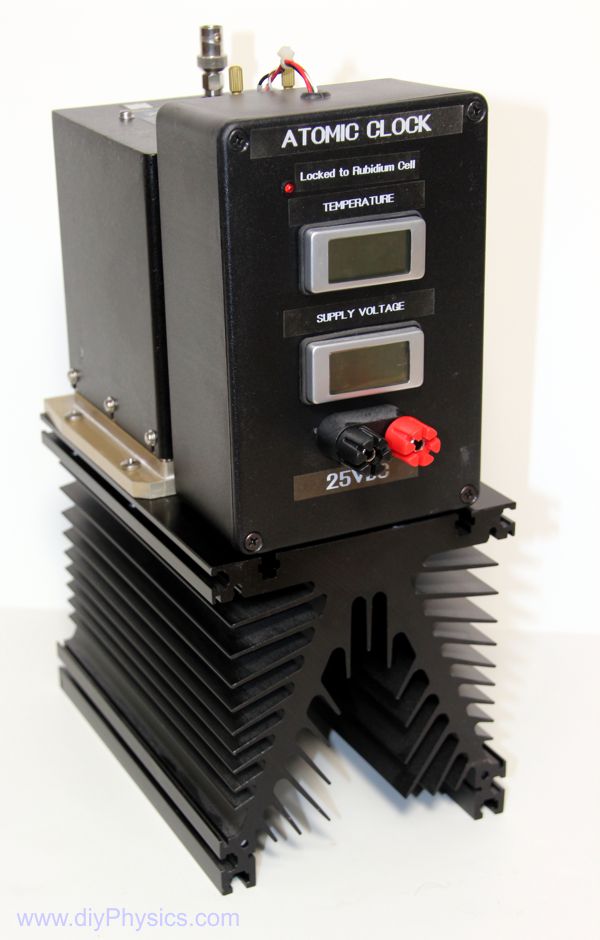
diy Rubidium Atomic Clock 10 Mhz Frequency Reference by David Prutchi Ph.D. www.diyPhysics.com

Efratom Model M-100 Rubidium Frequency Standard (RFS) oscillators are widely available in the surplus market.  Units on eBay commonly sell in the $150 to $200 range.  Despite their low surplus price, they were originally very expensive components, with superb performance.  The M100 was designed to be used by the military as a master oscillator in high-performance communication systems, frequency standard equipment, advanced navigation equipment, and all other systems which require extremely precise frequencies and time intervals.

With the proper input power provided and suitable cooling provisions, you can turn a surplus M-100 into a free-standing 10 MHz +/-5×10-11  (+/-5 x 10 ^-11 in case that your web browser doesn’t display the superscript font) frequency standard for frequency counters, as well as a precise calibration source.  I use mine to keep precise track of frequency when working on Earth-Moon-Earth (EME) communications, where even tiny errors in tuning can make the difference between success and failure to receive weak echoes.

The Efratom M100, Part Number (P/N)70502-1, is a sub-compact, lightweight, atomic resonance-controlled oscillator. The unit provides a pure and stable 10 MHz sinusoidal signal from a 10 MHz voltage-controlled crystal oscillator (VCXO), which is referenced and locked to the hyperfine transition of Rubidium 87.  The reference element is an optically-pumped integrated rubidium 87Rb vapor cell, contained within the “physics package.”

The long-term stability of the Efratom M100 is better than  6×10-11/month (< 3.6×10⁻¹⁰ for first year) improving to < 2×10⁻¹⁰/yr starting with the second year.
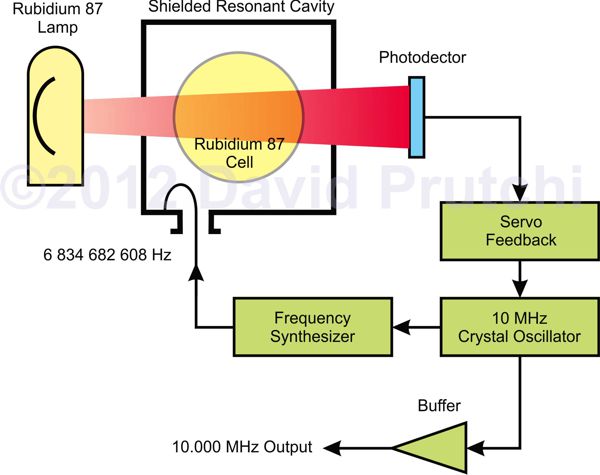
Block diagram of rubidium 87 frequency standard for diy atomic clock oscillator by David Prutchi, Ph.D.

The figure above shows a simplified block diagram of the rubidium standard.  A 10 MHz quartz crystal oscillator is “disciplined” to the rubidium hyperfine transition of 6 834 682 610.904 324 Hz. The amount of light from a rubidium discharge lamp that reaches a photodetector through a resonance cell will drop by about 0.1% when the rubidium vapor in the resonance cell is exposed to microwave power near the transition frequency. The crystal oscillator is stabilized to the rubidium transition by detecting the light dip while sweeping an RF synthesizer (referenced to the crystal) through the transition frequency.  When lock is achieved, the crystal oscillator’s frequency is exactly 10 MHz.
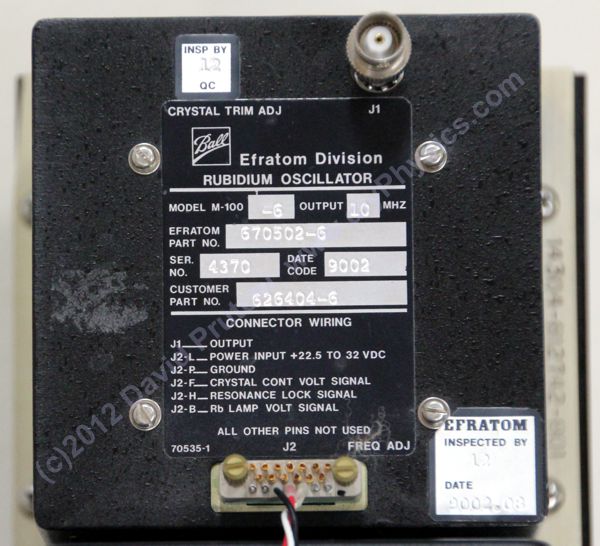
 

Efratom M100 d.i.y. rubidium atomic clock frequency standard by David Prutchi Ph.D.

The M100 needs to be mounted on a large heat sink.  I used one that I had in my junkbox.  I monitor temperature at the M100-heatsink interface with a Lascar model EMT-1900 thermometer LCD display.

Power and control signals to/from the M100 are all available at the connector marked J2.   This is a Winchester SGMC20 connector, and a suitable mating connector by Positronic is a 28748 type.  Pins are ordered as follows:

A D H L P T W

B E J M R U

C F K N S V X

In my setup, 25 VDC are supplied to the M100 via J2-Lfrom an external 3 A lab power supply.  The power supply line is monitored by a Lascar model EMV-1200 4-25V range, signal-powered LCD voltmeter.  Peak current during warm-up is up to 2.2 A at 25°C with 26 VDC input.

The M100 takes up to 10 minutes of warming-up to reach 10 MHz +/- 2×10⁻¹⁰ at 25 °C.  PLL lock is indicated with a low-current (2 mA) LED connected between the positive supply voltage and the lock indicator pin via a 15 kΩ resistor.

The M100’s 10 MHz output signal is available at SMA connector J1.  The output characteristics are:

  • Frequency: 10 MHz Sine Wave, (+/-5×10-11)
  • Amplitude: 0.5 vrms (-10%+30%) into 50 ohm load
  • Phase Noise (SSB 1 Hz BW): >120 dB at 100 Hz from carrier
  • (Signal-to-Noise): >130 dB at 1000 Hz from carrier
  • Harmonic Distortion: >-30 dBc
  • Non-Harmonic Distortion: >-80 dBc

Complete technical information for the module can be found in the m100 rubidium oscillator manual

Finally, the following picture shows the output of  my Efratom M100-based atomic frequency standard being compared to the output signal from a d.i.y. 10 MHz GPS-disciplined oscillator:

d.i.y. rubidium atomic clock frequency standard by David Prutchi Ph.D. measured against GPS-disciplined clock

Please visit www.diyPhysics.com for other cutting-edge d.i.y. projects, and remember to check out our new d.i.y. Quantum Physics book:

« d.i.y. Quantum Dot Synthesis
d.i.y. 15 kV @ 30 mA Floating-Output AC or DC High-Voltage Power Supply »

Buy our book at Amazon.com

Navigate diyphysics.com

  • Book
    • Book Contents
    • Adopt the Textbook
    • Back Cover
    • Instructor’s Guide
    • Software
    • Book Errata
  • About Us
  • Contact Us
  • Terms of Use
  • Privacy Policy

Categories

  • Administrative
  • Book Chapters
    • Chapter 1 – Light as a Wave
    • Chapter 2 – Light as Particles
    • Chapter 3 – Atoms and Radioactvity
    • Chapter 4 – The Priciple of Quantum Physics
    • Chapter 5 – Wave-Particle Duality
    • Chapter 6 – The Uncertainty Principle
    • Chapter 7 – Schrödinger's Wave Equation
    • Chapter 8 – Entanglement
  • Experiments
    • Attenuation of Radiation
    • Bell's Inequality Test
    • Compton Scattering
    • Doppler Effect
    • e/m Measurement
    • Emission Spectrometry
    • Entanglement
    • Glow Discharge
    • Ionizing Radiation Detection
    • Maltese Cross CRT
    • Plasma Physics
    • QKD
    • Quantum Dots
    • Quantum Random Number Generation
    • Quantum Tunneling
    • Radio-Isotope Identification
    • Relativistic Time Dilation
    • Rutherford Alpha-Particle Scattering
    • Single-Electron Experiments
    • Single-Photon Experiments
    • Single-Slit Diffraction
    • Two-Slit Interference
    • β-Particle Magnetic Deflection
  • Instrumentation
    • CDV700 Pro Geiger-Müller Counter
    • Electron-Beam Tube
    • Entangled-Photon Source
    • Gunnplexer Transceiver
    • High-Voltage Power Supply
    • Lasers
    • Mach-Zehnder Interferometer
    • Magneto-Optical Trap
    • Marx Generators
    • MCA/PHA
    • Photomultipliers
    • Photon/Coincidence Counter
    • PMT/Scintillation Processor
    • Polarimetric Imaging
    • Polymeric Radiation Detector
    • Precision Clocks and Timers
      • Atomic Clock
      • GPS-Disciplined
    • Radioisotopes
    • Scintillation Detector
    • Single-Photon Counting Modules (SPCMs)
    • Single-Photon Imaging
    • Spectrometer
    • Thermal Camera
    • Ultraviolet Illuminators
    • Vacuum System
  • Medium Wave Infrared Imaging
  • Nuclear Magnetic Resonance NMR
  • Physics Humor
  • Theoretical Physics
  • Ultraviolet Imaging
  • Uncategorized

Educational Resources

  • ALPhA Advanced Laboratory Physics Association
  • American Journal of Physics
  • Circuit Cellar
  • Dr. Enrique Galvez' Correlated-Photon Experiments Guide
  • Dr. Mark Beck's Undergraduate QM Experiments
  • The Bell Jar

Blogroll

  • Dorith Prutchi's Professional Website
  • More of our projects at prutchi.com
  • My Blog on Implantable Devices
  • My Infrared-to-UV Photography Site

Pages

  • Book
    • Book Contents
    • Adopt the Textbook
    • Back Cover
    • Instructor’s Guide
    • Software
    • Book Errata
  • About Us
  • Contact Us
  • Terms of Use
  • Privacy Policy

Archives

  • November 2023
  • September 2023
  • May 2021
  • March 2021
  • July 2019
  • November 2018
  • October 2018
  • April 2018
  • March 2018
  • November 2016
  • October 2016
  • September 2016
  • July 2016
  • March 2016
  • December 2015
  • November 2015
  • October 2015
  • September 2015
  • August 2015
  • July 2015
  • February 2014
  • December 2013
  • July 2013
  • May 2013
  • April 2013
  • March 2013
  • February 2013
  • January 2013
  • December 2012
  • October 2012
  • September 2012
  • August 2012
  • June 2012
  • May 2012
  • April 2012
  • March 2012
  • February 2012
  • January 2012
  • December 2011

Categories

  • Administrative (9)
  • Book Chapters (61)
    • Chapter 1 – Light as a Wave (2)
    • Chapter 2 – Light as Particles (10)
    • Chapter 3 – Atoms and Radioactvity (27)
    • Chapter 4 – The Priciple of Quantum Physics (3)
    • Chapter 5 – Wave-Particle Duality (13)
    • Chapter 6 – The Uncertainty Principle (2)
    • Chapter 7 – Schrödinger's Wave Equation (7)
    • Chapter 8 – Entanglement (18)
  • Experiments (57)
    • Attenuation of Radiation (2)
    • Bell's Inequality Test (8)
    • Compton Scattering (8)
    • Doppler Effect (2)
    • e/m Measurement (3)
    • Emission Spectrometry (2)
    • Entanglement (12)
    • Glow Discharge (1)
    • Ionizing Radiation Detection (18)
    • Maltese Cross CRT (1)
    • Plasma Physics (1)
    • QKD (3)
    • Quantum Dots (1)
    • Quantum Random Number Generation (3)
    • Quantum Tunneling (2)
    • Radio-Isotope Identification (7)
    • Relativistic Time Dilation (1)
    • Rutherford Alpha-Particle Scattering (1)
    • Single-Electron Experiments (1)
    • Single-Photon Experiments (22)
    • Single-Slit Diffraction (1)
    • Two-Slit Interference (4)
    • β-Particle Magnetic Deflection (2)
  • Instrumentation (79)
    • CDV700 Pro Geiger-Müller Counter (7)
    • Electron-Beam Tube (4)
    • Entangled-Photon Source (6)
    • Gunnplexer Transceiver (2)
    • High-Voltage Power Supply (10)
    • Lasers (3)
    • Mach-Zehnder Interferometer (1)
    • Magneto-Optical Trap (1)
    • Marx Generators (3)
    • MCA/PHA (10)
    • Photomultipliers (15)
    • Photon/Coincidence Counter (4)
    • PMT/Scintillation Processor (9)
    • Polarimetric Imaging (4)
    • Polymeric Radiation Detector (1)
    • Precision Clocks and Timers (3)
      • Atomic Clock (2)
      • GPS-Disciplined (1)
    • Radioisotopes (1)
    • Scintillation Detector (14)
    • Single-Photon Counting Modules (SPCMs) (12)
    • Single-Photon Imaging (3)
    • Spectrometer (1)
    • Thermal Camera (1)
    • Ultraviolet Illuminators (3)
    • Vacuum System (2)
  • Medium Wave Infrared Imaging (1)
  • Nuclear Magnetic Resonance NMR (3)
  • Physics Humor (9)
  • Theoretical Physics (1)
  • Ultraviolet Imaging (1)
  • Uncategorized (28)

WordPress

  • Log in
  • WordPress
© diy Physics Blog