diy Physics Blog

  • Book
    • Book Contents
    • Adopt the Textbook
    • Back Cover
    • Instructor’s Guide
    • Software
    • Book Errata
  • About Us
  • Contact Us
  • Terms of Use
  • Privacy Policy

Category Archives: Book Chapters

Using the $79 SainSmart DSO201 Pocket Oscilloscope and GammaGrapher with the PMT/Scintillation Probe

Posted on September 21, 2012 by David Prutchi Posted in Chapter 2 - Light as Particles, Chapter 3 - Atoms and Radioactvity, Chapter 5 - Wave-Particle Duality, Compton Scattering, MCA/PHA, Photomultipliers, PMT/Scintillation Processor, Scintillation Detector, Single-Photon Experiments

Connects directly to PMT probe shown in the book’s Figure 30 with no need for PMT amplifier!


Freeware Gamma Grapher MCA with diy PMT Scintillation Probe by David and Shanni Prutchi diyPhysics.com

The nice guys at the Yahoo GammaSpectrometry Group developed multichannel analyzer software for the $79 SainSmart DSO201 Pocket-Sized Digital Oscilloscope.  The upload of the MCA software to the oscilloscope is really easy (via USB), and it allows the PMT probe shown in the book’s Figure 30 to be connected directly to the oscilloscope’s input with no need for a PMT amplifier!
Continue reading→

A Low-Cost X-Band Generator for Microwave Optics Experiments

Posted on September 20, 2012 by David Prutchi Posted in Chapter 1 - Light as a Wave, Chapter 6 - The Uncertainty Principle, Chapter 7 - Schrödinger's Wave Equation, Doppler Effect, Gunnplexer Transceiver, Quantum Tunneling

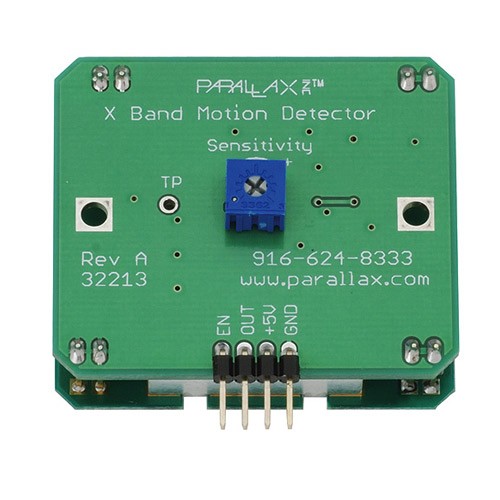
Parallax X-Band Microwave Transmitter for diy Quantum Tunneling and Microwave Optics Experiments

Gunnplexers are becoming scarce in the surplus market, but X-band motion detection is very much alive.  X-band detection modules are available for OEM applications, and fortunatelly, Parallax has a unit based on this module available for $34.99.

Continue reading→

diy Quantum Physics on MAKE Magazine (Volume 31)

Posted on September 2, 2012 by David Prutchi Posted in Administrative, Book Chapters

diy Quantum Physics was featured in Make Magazine, Volume 31:  Punk Science (page 76).

Two SPCMs on eBay at $400 Each (No Connection To Seller)

Posted on May 9, 2012 by David Prutchi Posted in Chapter 8 - Entanglement, Entanglement, Single-Photon Counting Modules (SPCMs), Single-Photon Experiments

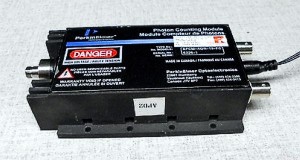
SPCMs for sale on eBayToday I found two Perkin Elmer SPCM-AQE-13-FC SPCMs for sale on eBay at $400 each.  eBay auction numbers are 280877451350 and 280877453169.  I am passing along this information in case that blog readers may be interested.  I have no connection whatsoever to seller.

New Isotope/Geiger Tube Holder at Images Scientific

Posted on April 22, 2012 by David Prutchi Posted in Attenuation of Radiation, CDV700 Pro Geiger-Müller Counter, Chapter 3 - Atoms and Radioactvity, Ionizing Radiation Detection, β-Particle Magnetic Deflection
Radioisotope/GM tube calibrated sled

Image Credit: Images Scientific Corporation

Images Scientific Corporation just announced a new Geiger counter wand base provides a stable platform to hold the Geiger counter wand for experiments. The physical dimensions of the holder are 2″ wide by 12″ long. The length of the sled has markings in both metric and imperial.

The sled isotope holder provides a stable and moveable platform for radioactive isotopes 1″ diameter discs. The sled isotope holder is available in two sizes:  One that holds 1/8″ thick discs and the other to hold 1/4″ thick discs.

When used in conjunction with the Sled isotope holder a number of nuclear experiments may be performed such as the Inverse Square Law of radiation, half life, shielding effects, etc.

Continue reading→

Perkin Elmer C30902E SPADs on eBay for $91 (Unrelated to Authors)

Posted on April 18, 2012 by David Prutchi Posted in Chapter 8 - Entanglement, Entanglement, Single-Photon Counting Modules (SPCMs), Single-Photon Experiments

Perkin Elmer Excelitas single photon avalanche photodiodes on eBay  www.diyPhysics.comSomeone (I don’t know the seller) is selling brand new Perkin Elmer C30902E Silicon Avalanche Photodiodes on eBay.  Auction number:  200747161278.

These are NOT chilled by a thermoelectric cooler, so their internal noise may be too large for experiments with entangled photons unless you rig some sort of external Peltier element to keep them chilled.  However, if you are developing a SPCM, using $91 SPADs during debugging is a lot better than frying $1,000 TE-cooled SPADs.

Continue reading→

d.i.y. Alpha-Particle Rutherford Scattering Experiment – Supplementary Pictures

Posted on March 3, 2012 by David Prutchi Posted in Chapter 3 - Atoms and Radioactvity, Polymeric Radiation Detector, Rutherford Alpha-Particle Scattering

diy Alpha-particle Rutherford scattering device by David and Shanni Prutchi www.diyPhysics.com

The book’s Figures 70 and 71 show our d.i.y. version of a popular apparatus to measure alpha particle scattering.  The figure above shows additional views to help you build your own.  The apparatus allows you to demonstrate alpha particle scattering discovered by Ernest Rutherford in 1908.  Fundamental to the discovery of the atom’s structure, the experiment demonstrates that the charge of the atomic nucleus is concentrated at the center of the atom. Continue reading→

Connecting to Surplus Scionix Miniature Scintillation Probes

Posted on February 20, 2012 by David Prutchi Posted in Chapter 3 - Atoms and Radioactvity, Chapter 5 - Wave-Particle Duality, Ionizing Radiation Detection, Photomultipliers, Radio-Isotope Identification, Scintillation Detector

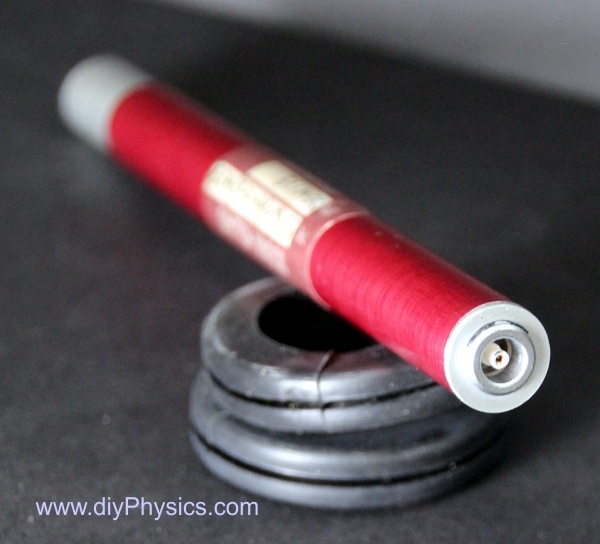
Scionix miniature photomultiplier scintillation probe David Prutchi PhD www.diyPhysics.com

Lemo connector on Scionix miniature photomultiplier scintillation probe David Prutchi PhD www.diyPhysics.com

Scionix in The Netherlands has taken advantage of the recent development of miniature mesh-type dynode photomultiplier tubes to construct small-diameter scintillation probes.  Scionix’s miniature probes incorporate one of those PMTs, a NaI(Tl) scintillation crystal, and a built-in dynode voltage divider.  Connection to the probe is made through a miniature high-voltage locking coaxial connector.  Finding a mating connector is the main problem faced by enthusiasts who find these probes in the surplus market. Continue reading→

Simple d.i.y. Bias-T for Scintillation Probes with Single Connector

Posted on February 20, 2012 by David Prutchi Posted in Chapter 3 - Atoms and Radioactvity, Chapter 4 - The Priciple of Quantum Physics, MCA/PHA, Photomultipliers, PMT/Scintillation Processor, Radio-Isotope Identification

diy Signal/High-Voltage Splitter for Scintillation Probe with Single Connector David Prutchi www.diyphysics.comMany surplus scintillation probes have a single connector through which the PMT is fed with high voltage and the anode signal is output.  However, this may require an external “Bias-T” (a high voltage / signal splitter) to connect the probe to a high-voltage power supply that is separate from the PMT amplifier/processor. Continue reading→
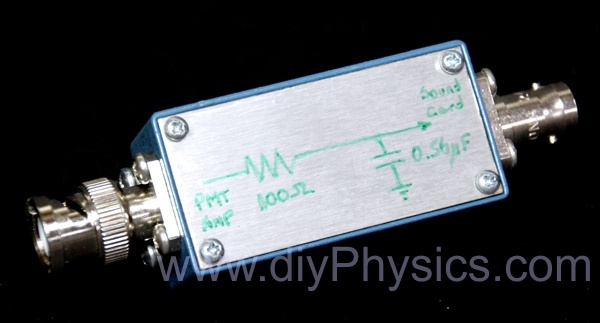
Simple d.i.y. Low-Pass Filter for Interfacing PMT Amplifier to PC Sound Card (Used with Free “Pulse Recorder and Analyser” Software MCA)

Posted on February 20, 2012 by David Prutchi Posted in Chapter 5 - Wave-Particle Duality, MCA/PHA, PMT/Scintillation Processor, Radio-Isotope Identification

diy low pass filter interface between photomultiplier scintillation probe amplifier and PRA by David Prutchi Ph.D. www.diyPhysics.comFigure 34 in the book shows the schematic diagram for our photomultiplier tube (PMT) signal processing circuit has an analog output that is suitable for use with a sound-card-based multichannel pulse-height analyzer (MCA).  However, if you already have a commercial scintillation processor that you would like to use with PRA, then you will somehow need to extend the typically narrow output pulses (e.g. 1 to 10 microseconds) so that they can be acquired through the sound card. Continue reading→

d.i.y. Quantum Dot Synthesis

Posted on February 12, 2012 by David Prutchi Posted in Chapter 7 - Schrödinger's Wave Equation, Quantum Dots

CdSe nanoparticle suspension of quantum dots of the type used by David and Shanni Prutchi www.diyphysics.comExperimental chemistry is not our forte, so we prefer to use professionally-manufactured quantum dots for the Schrödinger’s Wave Equation experiments we discuss in the book‘s Chapter 7.  However, if you are interested in synthesizing your own quantum-dot nanoparticle suspensions, we recommend that you take a look at the detailed instructions prepared by  Professor George Lisensky at Beloit College for the Preparation of Cadmium Selenide Quantum Dot Nanoparticles (Local printer-friendly copy at: CdSe_Quantum_Dot_Synthesis). Continue reading→

Adding Your Own Primary to High-Voltage Flyback Transformer for Resonant Driving

Posted on February 10, 2012 by David Prutchi Posted in Chapter 3 - Atoms and Radioactvity, High-Voltage Power Supply 3 Comments

High voltage flyback transformer by David and Shanni Prutchi www.diyphysics.com

Our two prior posts show how to build very high voltage power supplies using flybacks from old color TVs.  The advantage of the method we use is that any flyback can be driven, regardless of how its primary is wired.  This is because we wind our own primary using litz wire. Continue reading→

Universal Resonant Transformer Driver (High-Voltage Flyback Driver)

Posted on February 10, 2012 by David Prutchi Posted in Chapter 3 - Atoms and Radioactvity, High-Voltage Power Supply

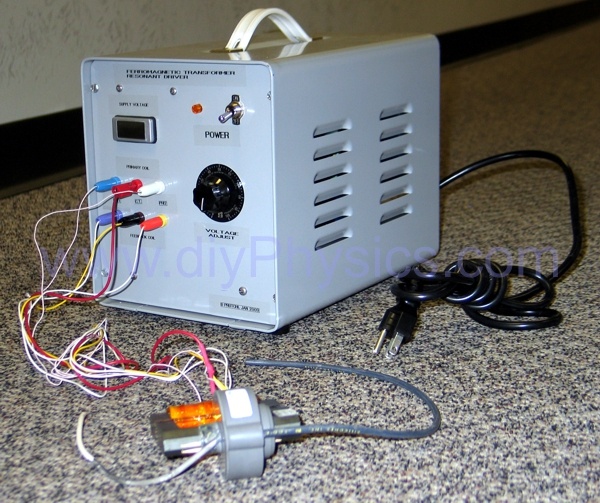
Universal resonant transformer driver by David and Shanni Prutchi www.diyPhysics.com

We use the flyback-driver circuit shown in our d.i.y. 250 kV DC power supply in many other of our setups, so we built a stand-alone universal resonant transformer driver.  Continue reading→

d.i.y. 250 kV High Voltage DC Power Supply with Neat Trick for Switching Polarity

Posted on February 9, 2012 by David Prutchi Posted in Chapter 3 - Atoms and Radioactvity, High-Voltage Power Supply

d.i.y. 300 kV DC high voltage power supply by David and Shanni Prutchi

High voltage DC power supplies are used by science enthusiasts for powering electron tubes and x-ray tubes, charging high-voltage capacitors, powering electrostatic “levitators”, etc.  Many of these power supplies use a flyback transformer to produce high voltage at high frequency (AC), followed by a “Cockroft-Walton Multiplier” to rectify and dramatically increase the voltage.

The Cockroft-Walton multiplier uses a cascaded series of diodes and capacitors to generate a high voltage DC potential from an AC input through a circuit topology that uses diodes to charge capacitors in parallel and discharge them in series.  The output polarity of the Cockroft-Walton multiplier depends on the way in which its diodes are oriented, so the output polarity (referenced to ground) of a high-voltage DC power supply is usually set during the design.

However, since some of our physics experiments require one or the other polarity, we build our Cockroft-Walton multipliers with an extra capacitor so that we can make our HV power supplies output either positive or negative high voltage referenced to ground.  Continue reading→

Home-Built Radiac (Radiation Detector and Meter) for a Surplus DT-590A/PDR-56F Scintillation Probe

Posted on February 2, 2012 by David Prutchi Posted in Chapter 3 - Atoms and Radioactvity, Ionizing Radiation Detection, Photomultipliers, Radio-Isotope Identification, Scintillation Detector

Home-Made PDR-56F Radiac for a surplus DT-590A/PDR-56F Plutonium Contamination Probe

Military DT-590A/PDR-56 “x-ray” probes are widely available in the surplus market.  They were meant to be used with the military Radiac Set AN/PDR-56, which is a portable scintillation-type instrument used for detection of plutonium-239 contamination. In addition to emitting 5.1 MeV alpha particles, Plutonium-239 also emits gamma rays in the energy range of 14 to 21 keV. Because these gamma rays are more penetrating than the alpha particles, they travel further in matter and air and can be detected at longer distances from the ground. The probe uses a CaF2(Eu) scintillator/photomultiplier combination to detect these 14-21 keV gammas from Pu-239. The discriminator inside the probe is factory-tuned to detect only pulses from the Pu-239 gamma rays. Hopefully you don’t have plutonium contamination in your basement, so you can set the discriminator window wide open to make the probe sensitive to a much wider range of gamma energies. In addition, you can replace the CaF2(Eu) crystal by a NaI(Tl) scintillation crystal assembly. This will turn the instrument into a general-purpose gamma radiation detector that will outperform virtually any handheld Geiger counter in the detection of 100keV to 1.3MeV photons.

PDR56 Circuit Continue reading→

Buy our book at Amazon.com

Navigate diyphysics.com

  • Book
    • Book Contents
    • Adopt the Textbook
    • Back Cover
    • Instructor’s Guide
    • Software
    • Book Errata
  • About Us
  • Contact Us
  • Terms of Use
  • Privacy Policy

Categories

  • Administrative
  • Book Chapters
    • Chapter 1 – Light as a Wave
    • Chapter 2 – Light as Particles
    • Chapter 3 – Atoms and Radioactvity
    • Chapter 4 – The Priciple of Quantum Physics
    • Chapter 5 – Wave-Particle Duality
    • Chapter 6 – The Uncertainty Principle
    • Chapter 7 – Schrödinger's Wave Equation
    • Chapter 8 – Entanglement
  • Experiments
    • Attenuation of Radiation
    • Bell's Inequality Test
    • Compton Scattering
    • Doppler Effect
    • e/m Measurement
    • Emission Spectrometry
    • Entanglement
    • Glow Discharge
    • Ionizing Radiation Detection
    • Maltese Cross CRT
    • Plasma Physics
    • QKD
    • Quantum Dots
    • Quantum Random Number Generation
    • Quantum Tunneling
    • Radio-Isotope Identification
    • Relativistic Time Dilation
    • Rutherford Alpha-Particle Scattering
    • Single-Electron Experiments
    • Single-Photon Experiments
    • Single-Slit Diffraction
    • Two-Slit Interference
    • β-Particle Magnetic Deflection
  • Instrumentation
    • CDV700 Pro Geiger-Müller Counter
    • Electron-Beam Tube
    • Entangled-Photon Source
    • Gunnplexer Transceiver
    • High-Voltage Power Supply
    • Lasers
    • Mach-Zehnder Interferometer
    • Magneto-Optical Trap
    • Marx Generators
    • MCA/PHA
    • Photomultipliers
    • Photon/Coincidence Counter
    • PMT/Scintillation Processor
    • Polarimetric Imaging
    • Polymeric Radiation Detector
    • Precision Clocks and Timers
      • Atomic Clock
      • GPS-Disciplined
    • Radioisotopes
    • Scintillation Detector
    • Single-Photon Counting Modules (SPCMs)
    • Single-Photon Imaging
    • Spectrometer
    • Thermal Camera
    • Ultraviolet Illuminators
    • Vacuum System
  • Medium Wave Infrared Imaging
  • Nuclear Magnetic Resonance NMR
  • Physics Humor
  • Theoretical Physics
  • Ultraviolet Imaging
  • Uncategorized

Educational Resources

  • ALPhA Advanced Laboratory Physics Association
  • American Journal of Physics
  • Circuit Cellar
  • Dr. Enrique Galvez' Correlated-Photon Experiments Guide
  • Dr. Mark Beck's Undergraduate QM Experiments
  • The Bell Jar

Blogroll

  • Dorith Prutchi's Professional Website
  • More of our projects at prutchi.com
  • My Blog on Implantable Devices
  • My Infrared-to-UV Photography Site
  • Prev
  • 1
  • 2
  • 3
  • 4
  • 5
  • Next

Pages

  • Book
    • Book Contents
    • Adopt the Textbook
    • Back Cover
    • Instructor’s Guide
    • Software
    • Book Errata
  • About Us
  • Contact Us
  • Terms of Use
  • Privacy Policy

Archives

  • November 2023
  • September 2023
  • May 2021
  • March 2021
  • July 2019
  • November 2018
  • October 2018
  • April 2018
  • March 2018
  • November 2016
  • October 2016
  • September 2016
  • July 2016
  • March 2016
  • December 2015
  • November 2015
  • October 2015
  • September 2015
  • August 2015
  • July 2015
  • February 2014
  • December 2013
  • July 2013
  • May 2013
  • April 2013
  • March 2013
  • February 2013
  • January 2013
  • December 2012
  • October 2012
  • September 2012
  • August 2012
  • June 2012
  • May 2012
  • April 2012
  • March 2012
  • February 2012
  • January 2012
  • December 2011

Categories

  • Administrative (9)
  • Book Chapters (61)
    • Chapter 1 – Light as a Wave (2)
    • Chapter 2 – Light as Particles (10)
    • Chapter 3 – Atoms and Radioactvity (27)
    • Chapter 4 – The Priciple of Quantum Physics (3)
    • Chapter 5 – Wave-Particle Duality (13)
    • Chapter 6 – The Uncertainty Principle (2)
    • Chapter 7 – Schrödinger's Wave Equation (7)
    • Chapter 8 – Entanglement (18)
  • Experiments (57)
    • Attenuation of Radiation (2)
    • Bell's Inequality Test (8)
    • Compton Scattering (8)
    • Doppler Effect (2)
    • e/m Measurement (3)
    • Emission Spectrometry (2)
    • Entanglement (12)
    • Glow Discharge (1)
    • Ionizing Radiation Detection (18)
    • Maltese Cross CRT (1)
    • Plasma Physics (1)
    • QKD (3)
    • Quantum Dots (1)
    • Quantum Random Number Generation (3)
    • Quantum Tunneling (2)
    • Radio-Isotope Identification (7)
    • Relativistic Time Dilation (1)
    • Rutherford Alpha-Particle Scattering (1)
    • Single-Electron Experiments (1)
    • Single-Photon Experiments (22)
    • Single-Slit Diffraction (1)
    • Two-Slit Interference (4)
    • β-Particle Magnetic Deflection (2)
  • Instrumentation (79)
    • CDV700 Pro Geiger-Müller Counter (7)
    • Electron-Beam Tube (4)
    • Entangled-Photon Source (6)
    • Gunnplexer Transceiver (2)
    • High-Voltage Power Supply (10)
    • Lasers (3)
    • Mach-Zehnder Interferometer (1)
    • Magneto-Optical Trap (1)
    • Marx Generators (3)
    • MCA/PHA (10)
    • Photomultipliers (15)
    • Photon/Coincidence Counter (4)
    • PMT/Scintillation Processor (9)
    • Polarimetric Imaging (4)
    • Polymeric Radiation Detector (1)
    • Precision Clocks and Timers (3)
      • Atomic Clock (2)
      • GPS-Disciplined (1)
    • Radioisotopes (1)
    • Scintillation Detector (14)
    • Single-Photon Counting Modules (SPCMs) (12)
    • Single-Photon Imaging (3)
    • Spectrometer (1)
    • Thermal Camera (1)
    • Ultraviolet Illuminators (3)
    • Vacuum System (2)
  • Medium Wave Infrared Imaging (1)
  • Nuclear Magnetic Resonance NMR (3)
  • Physics Humor (9)
  • Theoretical Physics (1)
  • Ultraviolet Imaging (1)
  • Uncategorized (28)

WordPress

  • Log in
  • WordPress
© diy Physics Blog