
 Experimental chemistry is not our forte, so we prefer to use professionally-manufactured quantum dots for the Schrödinger’s Wave Equation experiments we discuss in the book‘s Chapter 7. However, if you are interested in synthesizing your own quantum-dot nanoparticle suspensions, we recommend that you take a look at the detailed instructions prepared by Professor George Lisensky at Beloit College for the Preparation of Cadmium Selenide Quantum Dot Nanoparticles (Local printer-friendly copy at: CdSe_Quantum_Dot_Synthesis). Continue reading
Author Archives: David Prutchi
Adding Your Own Primary to High-Voltage Flyback Transformer for Resonant Driving

Our two prior posts show how to build very high voltage power supplies using flybacks from old color TVs. The advantage of the method we use is that any flyback can be driven, regardless of how its primary is wired. This is because we wind our own primary using litz wire. Continue reading
Universal Resonant Transformer Driver (High-Voltage Flyback Driver)
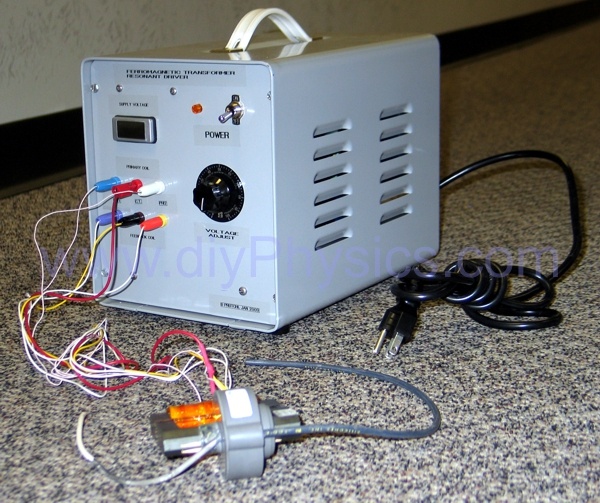
We use the flyback-driver circuit shown in our d.i.y. 250 kV DC power supply in many other of our setups, so we built a stand-alone universal resonant transformer driver. Continue reading
d.i.y. 250 kV High Voltage DC Power Supply with Neat Trick for Switching Polarity

High voltage DC power supplies are used by science enthusiasts for powering electron tubes and x-ray tubes, charging high-voltage capacitors, powering electrostatic “levitators”, etc. Many of these power supplies use a flyback transformer to produce high voltage at high frequency (AC), followed by a “Cockroft-Walton Multiplier” to rectify and dramatically increase the voltage.
The Cockroft-Walton multiplier uses a cascaded series of diodes and capacitors to generate a high voltage DC potential from an AC input through a circuit topology that uses diodes to charge capacitors in parallel and discharge them in series. The output polarity of the Cockroft-Walton multiplier depends on the way in which its diodes are oriented, so the output polarity (referenced to ground) of a high-voltage DC power supply is usually set during the design.
However, since some of our physics experiments require one or the other polarity, we build our Cockroft-Walton multipliers with an extra capacitor so that we can make our HV power supplies output either positive or negative high voltage referenced to ground. Continue reading
Engineer’s Date Night

Image Credit: Daniel Vasconcellos
From: http://www.edn.com/article/471834-Something_from_nothing.php
d.i.y. CW CO2 Laser Power Meter Posted at www.prutchi.com
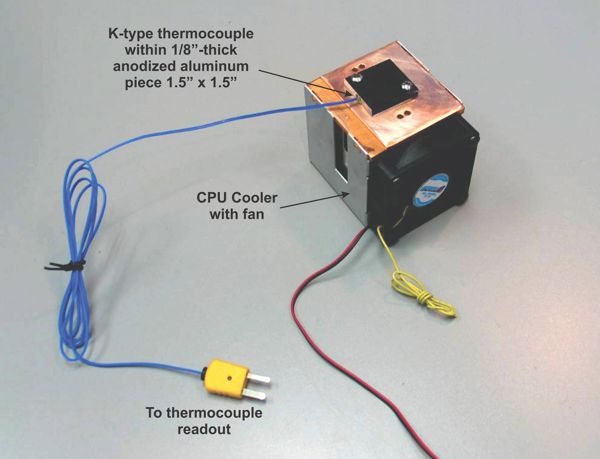
I just posted at www.prutchi.com the construction of a simple, but very useful laser power meter. I used it to tune my 18 W CO2 laser, but the concept is applicable to any other high-power CW laser. Click here for a direct link to the blog post.
Home-Built Radiac (Radiation Detector and Meter) for a Surplus DT-590A/PDR-56F Scintillation Probe

Military DT-590A/PDR-56 “x-ray” probes are widely available in the surplus market. They were meant to be used with the military Radiac Set AN/PDR-56, which is a portable scintillation-type instrument used for detection of plutonium-239 contamination. In addition to emitting 5.1 MeV alpha particles, Plutonium-239 also emits gamma rays in the energy range of 14 to 21 keV. Because these gamma rays are more penetrating than the alpha particles, they travel further in matter and air and can be detected at longer distances from the ground. The probe uses a CaF2(Eu) scintillator/photomultiplier combination to detect these 14-21 keV gammas from Pu-239. The discriminator inside the probe is factory-tuned to detect only pulses from the Pu-239 gamma rays. Hopefully you don’t have plutonium contamination in your basement, so you can set the discriminator window wide open to make the probe sensitive to a much wider range of gamma energies. In addition, you can replace the CaF2(Eu) crystal by a NaI(Tl) scintillation crystal assembly. This will turn the instrument into a general-purpose gamma radiation detector that will outperform virtually any handheld Geiger counter in the detection of 100keV to 1.3MeV photons.
Converting a DT-590A/PDR-56F “X-Ray” Probe into a General-Purpose NaI(Tl) Gamma Probe
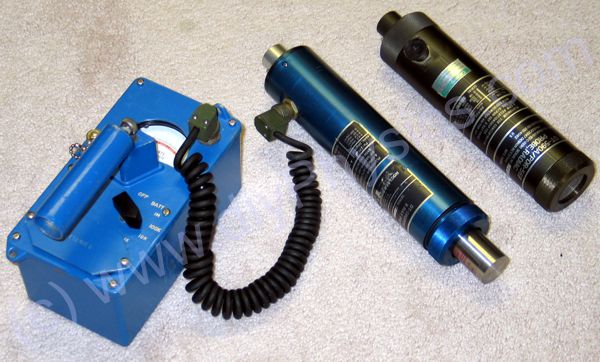
The military Radiac Set, AN/PDR-56 is a portable scintillation type instrument used for detection of alpha contamination. The system includes a large and small interchangeable probe with a probe extension. This system is being phased out by the US Air Force, so new probes are becoming widely available in the surplus market.
The “x-ray” probe for the AN/PDR-56 uses a CaF2(Eu) scintillator/photomultiplier combination to detect the 14-21 keV gammas from Pu-239. The x-ray probe is an assembly which includes the amplifier-discriminator circuits integral to the phototube scintillator housing. The discriminator is a single channel analyzer adjusted to detect Pu-239 gamma rays. Continue reading
Open-Source Handheld Gamma Spectrometer on Yahoo Group GammaSpectrometry

An amateur-use open-source gamma spectrum analyzer is being developed by members of the GeigerCounterEnthusiast (GCE) Yahoo Group. This multichannel analyzer (MCA) is based on the STM32F103VBT6 microcontroller. It displays spectra on a color LCD.
To access the design files (and hopefully to participate in the development) you will need to join the GammaSpectrometry Yahoo Group (free membership). Join through: http://groups.yahoo.com/ Continue reading
d.i.y. Handheld Multichannel Analyzer (MCA) based on 16F877 PIC Microcontroller and LCD

Some time ago I was developing a medical instrument which required histogramming, which got me in the mood to retake my own PIC MCA project(http://home.comcast.net/~prutchi/index_files/scint.htm ). I used the variable RAM in the microcontroller (16F877), so I limited the number of channels to 95 and let the histogram run until some channel reaches 240 counts (the highest 8-bit number that yields an integer when divided by 8 which is also divisible by the 30 pixel height of the LCD). The firmware then displays the spectrum as a bar with a maximum height of 30 pixels for each one of the 95 channels. Continue reading
Prototyping PCB for d.i.y. Photomultiplier (PMT) Amplifier/Processor

We built the bulk of our PMT amplifier/processor/discriminator on a Universal PDIP Operational Amplifier Evaluation Module by Texas Instruments (model OPAMPEVM-PDIP). Click on the picture above for a full-size version of the picture.
The diagram in the following pdf file shows the connection layout for the circuit shown in the book’s Figure 34: PMT Processor PCB Continue reading
d.i.y. Mod for Perkin Elmer SPCM-AQR Single-Photon Detector Module to Improve Photon Timing Performance
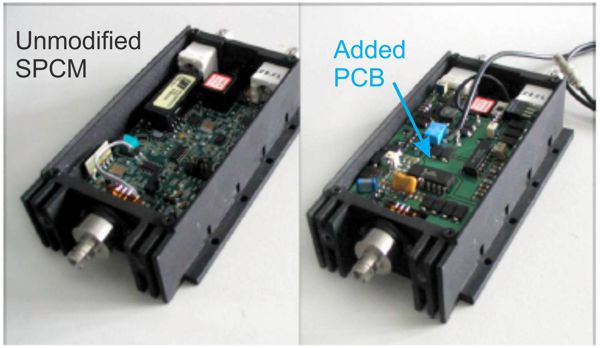 I. Rech, I. Labanca, M. Ghioni, and S. Cova of the Politecnico di Milano in Italy described an interesting modification to the Perkin Elmer SPCM-AQR Single-Photon Counting Module (SPCM) to improve its timing characteristics in:
I. Rech, I. Labanca, M. Ghioni, and S. Cova, “Modified single photon counting modules for optimal timing performance“, Rev. Sci. Instrum. 77, 033104 (2006); doi:10.1063/1.2183299 (5 pages). Continue reading
Matlab Video Frame Integration Program Using VCAPG2 for Single-Photon Double-Slit Interference Experiment

In Chapter 5 of the book we list a short Matlab® program to integrate successive video frames from our diy intensified camera to image double-slit interference patterns obtained by shooting a single photon at a time.
The program listed in the book uses Vision for Matlab (VFM). However, this utility is not compatible with all versions of Windows and Matlab. An alternative is VCAPG2 by Kazuyuki Kobayashi available at http://www.ikko.k.hosei.ac.jp/~matlab/matkatuyo/vcapg2.htm (Also available from our SOFTWARE page). Continue reading
DN1221 Thermoelectric Controller for d.i.y. Single-Photon Counter Module
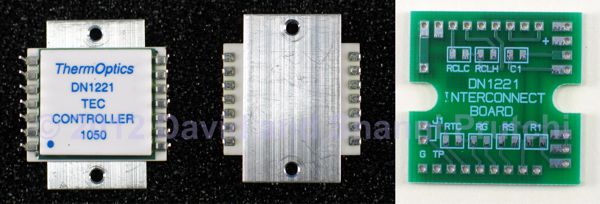 Figure 144 in the book shows the schematic diagram for our d.i.y. thermoelectrically cooled single-photon avalanche photodiode (SPAD). Our design calls for a ThermOptics DN1225 TEC controller. However, this model is not available any more. Fortunatelly, the ThermOptics’ DN1221 subminiature Bipolar Temperature Controller for Thermoelectric Coolers (TEC) is equally suitable by adapting the pinout and adjusting component values. Continue reading
We Received The First Copies of Our d.i.y. Quantum Physics Book!
 Today we received the first two copies of the book! Amazon’s website says that it will be shipping on January 29, 2012.
From the back cover:
“Build an intuitive understanding of the principles behind quantum mechanics through practical construction and replication of original experiments.
With easy-to-acquire, low-cost materials and basic knowledge of algebra and trigonometry, Exploring Quantum Physics through Hands-on Projects takes readers step by step through the process of re-creating scientific experiments that played an essential role in the creation and development of quantum mechanics.
Presented in near chronological order—from discoveries of the early twentieth century to new material on entanglement—this book includes question- and experiment-filled chapters on:
- Light as a Wave
- Light as Particles
- Atoms and Radioactivity
- The Principle of Quantum Physics
- Wave/Particle Duality
- The Uncertainty Principle
- Schrödinger (and his Zombie Cat)
- Entanglement
From simple measurements of Planck’s constant to testing violations of Bell’s inequalities using entangled photons, Exploring Quantum Physics through Hands-on Projects not only immerses readers in the process of quantum mechanics, it gives them insight into the history of the field—how the theories and discoveries apply to our world not only today . . . but also tomorrow.
By immersing readers in groundbreaking experiments that can be performed at home, school, or in the lab, this first-ever, hands-on book successfully demystifies the world of quantum physics for all who seek to explore it—from science enthusiasts and undergrad physics students to practicing physicists and engineers.”