diy Physics Blog

  • Book
    • Book Contents
    • Adopt the Textbook
    • Back Cover
    • Instructor’s Guide
    • Software
    • Book Errata
  • About Us
  • Contact Us
  • Terms of Use
  • Privacy Policy

Author Archives: David Prutchi

New, Complete Version of DOLPi Whitepaper Available

Posted on September 19, 2015 by David Prutchi Posted in Uncategorized

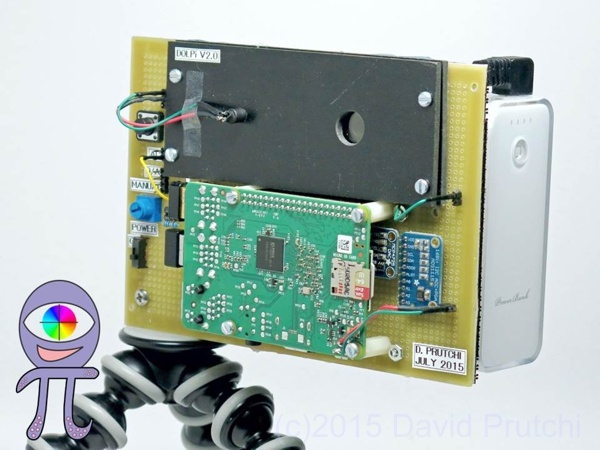
DOLPi polarimetric cameras by David Prutchi

A new, complete version of the whitepaper on DOLPi is available for download here:  DOLPi_Polarimetric_Camera_D_Prutchi_2015_v2

This paper presents the development and construction of two low-cost polarimetric cameras based on the Raspberry Pi 2.  “DOLPi-MECH” is a filter-wheel-type camera capable of performing full Stokes analysis, while the electro-optic based “DOLPi” camera performs full linear polarimetric analysis at higher frame rate.  Complete Python code for polarimetric imaging is presented.  Various applications for the cameras are described, especially its use for locating mines and unexploded ordinance in humanitarian demining operations.

DOLPi_Mech: A Slower But Accurate Imaging Polarimeter

Posted on August 24, 2015 by David Prutchi Posted in Uncategorized

DOLPi-Mech Filter Wheel Polarimetric Camera David Prutchi Ph.D.

The image that the liquid-crystal-panel-based DOLPi takes at “45 degrees” is not strictly that, which is why I state in the paper:

“Bossa Nova’s method is straightforward if laboratory optical-grade components are used. These are very expensive and out of reach for most private enthusiasts. However, I found through experimentation that a welding mask LCP and a polarizer sheet can also give very satisfactory results.”

In reality, the LCP driven half-way acts as a quarter-wave plate, and hence the strict interpretation of the analysis at this level is for circular polarization rather than linear polarization at 45 degrees.

I didn’t want to go into a thorough explanation of polarization optics to keep the project accessible, but based on my experiments, I’m convinced that DOLPi’s “45 degree image” indeed contains a dominant 45 degree component when observing linearly polarized light.

This weekend I decided to build a mechanical filter-wheel-based polarimetric camera to serve as a basis for comparison to the LCP_based DOLPi. This camera is much slower than the LCP-based DOLPi because of the mechanical switching of filters, but it provides the data necessary for complete Stokes imaging (including the fourth Stokes parameter describing circular polarization). The pictures that it produces are of excellent quality!

Continue reading→

DOLPi is a Hack-a-Day 2015 Semifinalist!

Posted on August 24, 2015 by David Prutchi Posted in Uncategorized

HackadayPrize

“From: no-reply-projects@hackaday.com

Sent: Monday, August 24, 2015 9:39 AM

To: david@…

Subject: Your Project is a Semifinalist in the 2015 Hackaday Prize!

Dear David Prutchi,

Congratulations! We think your DOLPi – RasPi Polarization Camera is awesome and you are one of our top 100 picks for the Hackaday Prize. You are advancing to the next round.

What happens now? We are announcing this in a short bit on Hackaday and this is a good time for you to tell everyone that your product is now in the running for a trip to space! Spaaaace!

…”

Hack-A-Day 2015 Prize DOLPi Submission Video

Posted on August 7, 2015 by David Prutchi Posted in Uncategorized

Hi! DOLPi is a low-cost polarization camera based on the Raspberry Pi.

Like intensity and color, polarization is another property of a light wave.

Humans cannot sense polarization, but many animals like cuttlefish and insects have polarization-sensitive vision that they use for navigation, finding water, and detecting transparent prey.

This is DOLPi – it is completely self-contained and easy to build. In spite of its simplicity, it holds truly awesome power for the development of brand new scientific and commercial applications!

Continue reading→

DOLPi’s first pictures outside the lab

Posted on July 30, 2015 by David Prutchi Posted in Uncategorized

Image taken with DOLPi Polarization camera (c)2015 David Prutchi, PhD

These are polarization images taken with DOLPi.  Colors represent Angle of Polarization

Image taken with DOLPi Polarization camera (c)2015 David Prutchi, PhD


DOLPi – A Low-Cost RasPi-based Polarization Camera

Posted on July 27, 2015 by David Prutchi Posted in Polarimetric Imaging

DOLPi – A Low-Cost RasPi-based Polarization Camera

A polarimetric imager to detect invisible pollutants, locate landmines, identify cancerous tissues, and maybe even observe cloaked UFOs!

DOLPi Polarimetric camera by David Prutchi, Ph.D. www.diyPhysics.com

The polarization of light carries interesting information about our visual environment of which we are usually unaware. Some animals have evolved the capability to see polarization as a distinct characteristic of light, and rely critically on this sense for navigation and survival. For example, many fish, amphibians, arthropods, and octopuses use polarization vision as a compass for navigation, to detect water surfaces, to enhance the detection of prey and predators, and probably also as a private means to communicate among each other.

While we have used technology to expand our vision beyond the limits of our ordinary wavelength and intensity sensitivities, the unintuitive nature of polarization has slowed down the development of practical applications for polarization imaging. Polarization cameras do exist, but at over $50,000, they are mostly research curiosities that have found very few practical uses outside the lab.

The DOLPi project aims to widely open the field of polarization imaging by constructing a very low cost polarization camera that can be used to research and develop game-changing applications across a wide range of fields – spanning all the way from environmental monitoring and medical diagnostics, to security and antiterrorism applications.

The DOLPi polarization camera is based on a standard Raspberry Pi 2 single-board computer and its dedicated 5MP camera. What makes the DOLPi unique is that the camera sits behind a software-controlled electro-optic polarization modulator, allowing the capture of images through an electronic polarization analyzer. The modulator itself is hacked from two low-cost auto-darkening welding mask filters ($9 each). In spite of its simplicity, DOLPi produces very high quality polarization images.

This is a first-of-its-kind project! I am not aware of any polarization imager ever presented as an enthusiast-level DIY project, yet it holds truly awesome disruptive power for the development of brand new scientific and commercial applications!

A complete description of this project in pdf format is available at: DOLPi_Polarimetric_Camera_D_Prutchi_2015_v2

Continue reading→

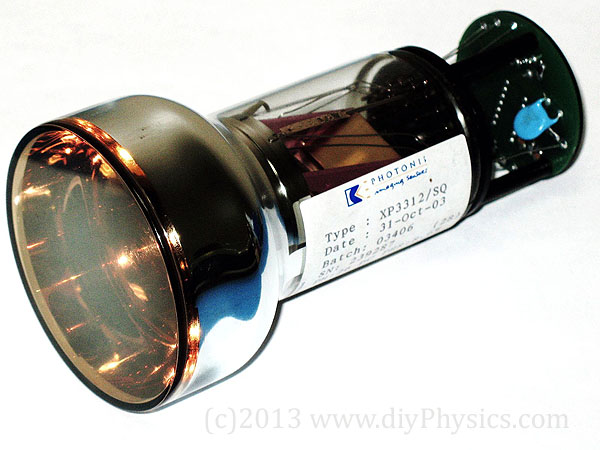
$25 Philips Medical Systems PMTs from Sphere Research

Posted on February 26, 2014 by David Prutchi Posted in Photomultipliers

Low-Cost Scintillation Probe Based on a Surplus XP3312 PMT for Ludlum Ratemeters www.diyPhysics.com prutchiSphere Research is clearing out all the Philips PMT assemblies they have in stock to empty their expensive off-site rental storage space. While stock is available, you can order any PMT shown as a Philips Medical Systems assembly at the beginning of this page for only $25 +shipping:

http://www.sphere.bc.ca/test/photo-tubes.html

Simply identify the deal as coming from DIY Physics when ordering (Note from diyPhysics.com: nothing in it for us except passing along some great info…).

All these tubes will be cleared out shortly so they can close down their over-priced off-site rental storage space. The offer is limited to stock on hand at the time of order. Sphere Research is happy to consolidate orders and help you minimize shipping costs wherever possible.  They can take Visa, MasterCard and PayPal for orders. These are very high performance tubes and hard to find, but they are very awkward for them to store in the big factory boxes, so they have to go.

Reader-Built e/m Measurement System Showcased on YouTube

Posted on December 8, 2013 by David Prutchi Posted in Chapter 3 - Atoms and Radioactvity, e/m Measurement, Electron-Beam Tube

Javier De Elias Cantalapiedra from Madrid, Spain posted the YouTube video above to show the e/m measurement system that he put together based on the description in our book.  His measurement system is based on Hoag’s method, and his nicely laid-out setup allowed him to obtain very nice results (4 to 6% error compared to the theoretical e/m).

Javier is an industrial engineer who works in the telecommunications industry.  However, his passion is physics, which he pursues at a (very high) amateur level.

Thank you Javier for sharing!


According to Quantum Mechanics…

Posted on July 21, 2013 by David Prutchi Posted in Physics Humor


Quantum Mechanical Effects in Microgravity

Posted on July 3, 2013 by David Prutchi Posted in Administrative, Physics Humor

Dorith and David Prutchi floating in zero g on board the "G Force One"

If there were any quantum effects to be seen, I wasn’t paying attention… Dorith (Mrs. diyPhysics) and I were having too much fun!

  httpv://youtu.be/iFr5OSR0sk8

Click here for photos of Day 1 in the G Force One zero-g airplane

Click here for photos of Day 2 in the G Force One zero-g airplane

For more information about Zero G go to http://www.gozerog.com/


EG&G SPCM-AQR-13-FC Single Photon Counting Module on eBay (no relation to seller)

Posted on May 14, 2013 by David Prutchi Posted in Bell's Inequality Test, Chapter 8 - Entanglement, Single-Photon Counting Modules (SPCMs), Single-Photon Experiments

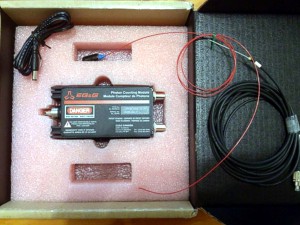
SPCM on eBay www.diyPhysics.comI HAVE NO RELATION TO SELLER – Just passing along in case someone is interested.
eBay item number 271206242864:

“The EG&G (or Perkin Elmer) SPCM-AQR is a self-contained module which detects single photons of light over the wavelength range from 400 nm to 1060 nm and sensitivity which often outperforms PMTs. The option 13-FC indicates 180 micron diameter Si APD, Dark Count < 250cps and FC connector attached.

I obtained this detector in working order five years ago and have not used it since then. The detector comes with two unknown optical fiber cables (one end: FC, the other end: bare fiber) and a supply cable to which you need to give 5V. No manual included. The US sale only.”

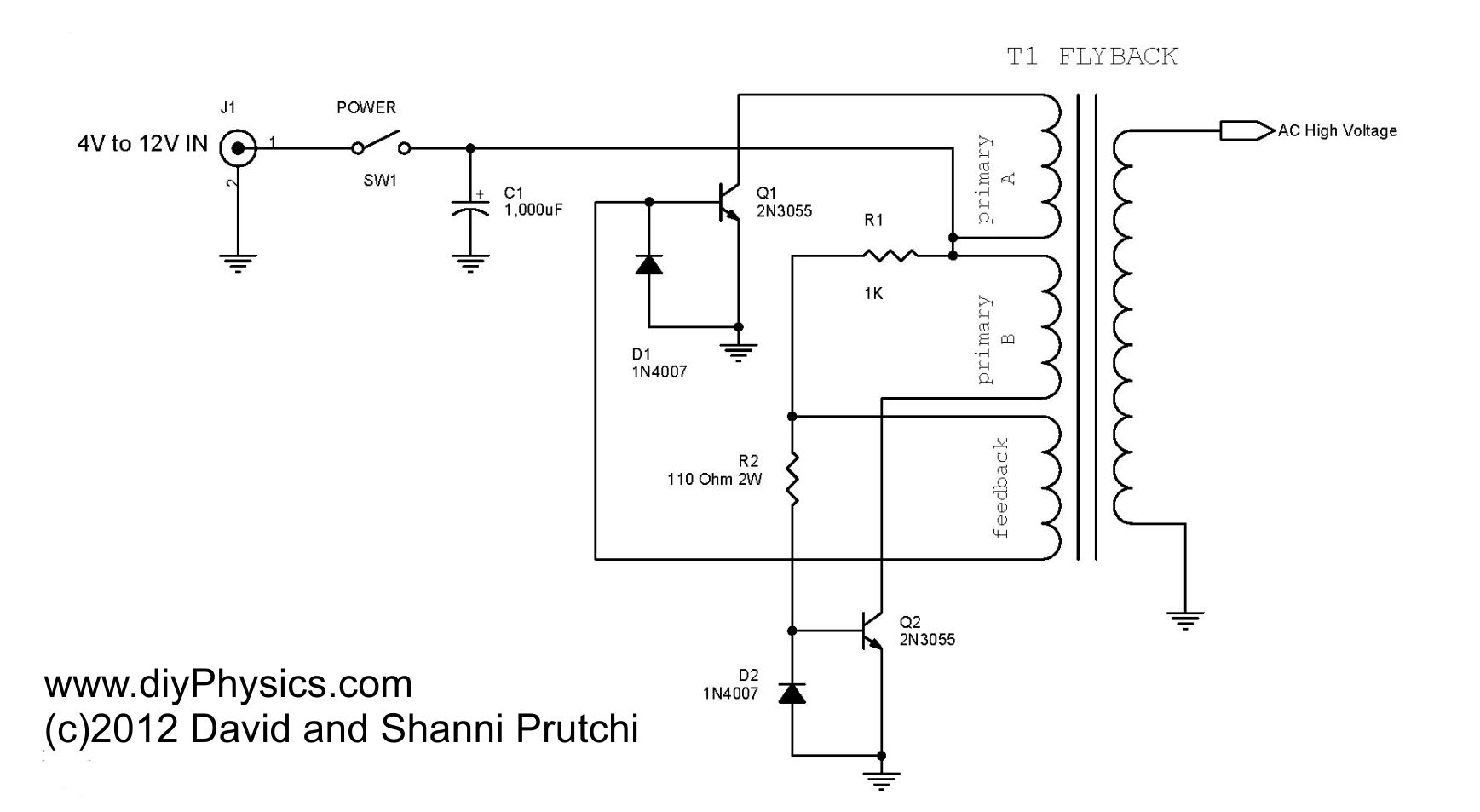
Original Source for Flyback Driver Hack?

Posted on May 8, 2013 by David Prutchi Posted in Chapter 3 - Atoms and Radioactvity, High-Voltage Power Supply

Flyback driver circuit from Radio Electronics September 1981 David Prutchi PhD www.diyPhysics.com

One of my all-time favorite circuits is the the following DC-to-AC inverter (click diagram to enlarge) based on an old color TV flyback:

High voltage AC driver for 250 kV DC power supply by David and Shanni Prutchi

Continue reading→

Fair Sampling Loophole Closed for Test of Violation of Bell’s Inequality

Posted on April 25, 2013 by David Prutchi Posted in Bell's Inequality Test, Chapter 8 - Entanglement, Single-Photon Counting Modules (SPCMs)


Loophole-free Bell's Inequality Violation David Prutchi PhD www.diyPhysics.com

From “Loophole-free Einstein–Podolsky–Rosen experiment via quantum steering”, New Journal of Physics, Volume 14, May 2012

A very interesting article by Bernhard Wittmann, Sven Ramelow, Fabian Steinlechner, Nathan K Langford, Nicolas Brunner, Howard M Wiseman, Rupert Ursin,and Anton Zeilinger, entitled “Loophole-free Einstein–Podolsky–Rosen experiment via quantum steering” appeared in the Nature’s New Journal of Physics, Volume 14, May 2012.

This paper describes a Bell’s Inequality Violation experiment in which the “fair sampling” loophole has been closed.  This loophole posits the possibility that classical – rather than quantum – effects could be responsible for measured correlations between entangled pairs of photons in a Bell’s Inequality Violation experiment.  The paper’s abstract reads:

“Tests of the predictions of quantum mechanics for entangled systems have provided increasing evidence against local realistic theories. However, there remains the crucial challenge of simultaneously closing all major loopholes—the locality, freedom-of-choice and detection loopholes—in a single experiment. An important sub-class of local realistic theories can be tested with the concept of ‘steering’. The term ‘steering’ was introduced by Schrödinger in 1935 for the fact that entanglement would seem to allow an experimenter to remotely steer the state of a distant system as in the Einstein–Podolsky–Rosen (EPR) argument. Einstein called this ‘spooky action at a distance’. EPR-steering has recently been rigorously formulated as a quantum information task opening it up to new experimental tests. Here, we present the first loophole-free demonstration of EPR-steering by violating three-setting quadratic steering inequality, tested with polarization-entangled photons shared between two distant laboratories. Our experiment demonstrates this effect while simultaneously closing all loopholes: both the locality loophole and a specific form of the freedom-of-choice loophole are closed by having a large separation of the parties and using fast quantum random number generators, and the fair-sampling loophole is closed by having high overall detection efficiency. Thereby, we exclude—for the first time loophole-free—an important class of local realistic theories considered by EPR. Besides its foundational importance, loophole-free steering also allows the distribution of quantum entanglement secure event in the presence of an untrusted party.”

Continue reading→

Loved the Book “How the Hippies Saved Physics” by David Kaiser

Posted on April 23, 2013 by David Prutchi Posted in Bell's Inequality Test, Chapter 8 - Entanglement, Physics Humor, QKD

How the Hippies Saved Physics www.diyPhysics.com David Prutchi PhDI just finished the book “How the Hippies Saved Physics” by David Kaiser and absolutely loved!

The book was fun and immensely educational regarding the seemingly unlikely seed of modern-day quantum information theory.  I must confess that when I first saw the book on the shelf at my local Barnes & Noble I dismissed it as yet another pseudo-scientific account of quantum physics.  However, I bought a copy after reading the following review in New Scientist:

“David Kaiser’s How the Hippies Saved Physics is a reminder of the unexpected influence a bunch of freewheeling 1970s physicists had on fundamental theories

IT’S certainly a provocative title, but for the life of me I could not recall an era to which How the Hippies Saved Physics might have applied. Things made more sense, though, on reading David Kaiser’s mention of two other books, both of which had left a big impression on me: Fritjof Capra’s The Tao of Physics and Gary Zukav’s The Dancing Wu Li Masters.

Continue reading→

Air to Ground Quantum Key Distribution Achieved

Posted on April 10, 2013 by David Prutchi Posted in Chapter 8 - Entanglement, QKD
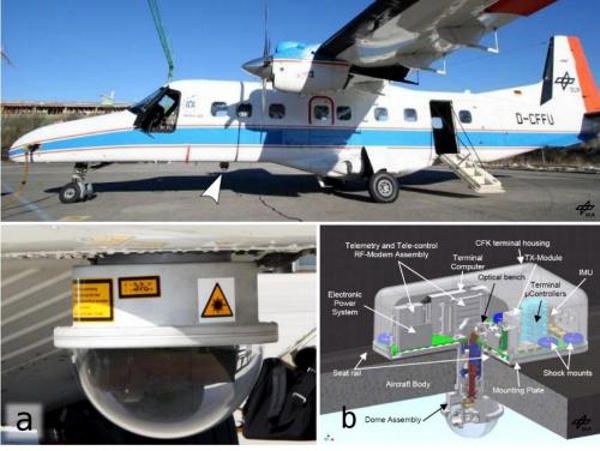
Quantum key distribution from airplane David Prutchi PhD www.diyPhysics.com

From Nauerth et al, “Air to Ground Quantum Key Distribution”

From Phys.org:

“A team of German physicists has successfully demonstrated an ability to perform quantum key distribution (QKD) exchange between an airplane in flight and a ground station, paving the way perhaps to the same kinds of communications between satellites and ground stations which could lead to a global quantum based secure communications network. The team presented their results at the QCrypt convention this past week.

Continue reading→

Buy our book at Amazon.com

Navigate diyphysics.com

  • Book
    • Book Contents
    • Adopt the Textbook
    • Back Cover
    • Instructor’s Guide
    • Software
    • Book Errata
  • About Us
  • Contact Us
  • Terms of Use
  • Privacy Policy

Categories

  • Administrative
  • Book Chapters
    • Chapter 1 – Light as a Wave
    • Chapter 2 – Light as Particles
    • Chapter 3 – Atoms and Radioactvity
    • Chapter 4 – The Priciple of Quantum Physics
    • Chapter 5 – Wave-Particle Duality
    • Chapter 6 – The Uncertainty Principle
    • Chapter 7 – Schrödinger's Wave Equation
    • Chapter 8 – Entanglement
  • Experiments
    • Attenuation of Radiation
    • Bell's Inequality Test
    • Compton Scattering
    • Doppler Effect
    • e/m Measurement
    • Emission Spectrometry
    • Entanglement
    • Glow Discharge
    • Ionizing Radiation Detection
    • Maltese Cross CRT
    • Plasma Physics
    • QKD
    • Quantum Dots
    • Quantum Random Number Generation
    • Quantum Tunneling
    • Radio-Isotope Identification
    • Relativistic Time Dilation
    • Rutherford Alpha-Particle Scattering
    • Single-Electron Experiments
    • Single-Photon Experiments
    • Single-Slit Diffraction
    • Two-Slit Interference
    • β-Particle Magnetic Deflection
  • Instrumentation
    • CDV700 Pro Geiger-Müller Counter
    • Electron-Beam Tube
    • Entangled-Photon Source
    • Gunnplexer Transceiver
    • High-Voltage Power Supply
    • Lasers
    • Mach-Zehnder Interferometer
    • Magneto-Optical Trap
    • Marx Generators
    • MCA/PHA
    • Photomultipliers
    • Photon/Coincidence Counter
    • PMT/Scintillation Processor
    • Polarimetric Imaging
    • Polymeric Radiation Detector
    • Precision Clocks and Timers
      • Atomic Clock
      • GPS-Disciplined
    • Radioisotopes
    • Scintillation Detector
    • Single-Photon Counting Modules (SPCMs)
    • Single-Photon Imaging
    • Spectrometer
    • Thermal Camera
    • Ultraviolet Illuminators
    • Vacuum System
  • Medium Wave Infrared Imaging
  • Nuclear Magnetic Resonance NMR
  • Physics Humor
  • Theoretical Physics
  • Ultraviolet Imaging
  • Uncategorized

Educational Resources

  • ALPhA Advanced Laboratory Physics Association
  • American Journal of Physics
  • Circuit Cellar
  • Dr. Enrique Galvez' Correlated-Photon Experiments Guide
  • Dr. Mark Beck's Undergraduate QM Experiments
  • The Bell Jar

Blogroll

  • Dorith Prutchi's Professional Website
  • More of our projects at prutchi.com
  • My Blog on Implantable Devices
  • My Infrared-to-UV Photography Site
  • Prev
  • 1
  • 2
  • 3
  • 4
  • Next

Pages

  • Book
    • Book Contents
    • Adopt the Textbook
    • Back Cover
    • Instructor’s Guide
    • Software
    • Book Errata
  • About Us
  • Contact Us
  • Terms of Use
  • Privacy Policy

Archives

  • November 2023
  • September 2023
  • May 2021
  • March 2021
  • July 2019
  • November 2018
  • October 2018
  • April 2018
  • March 2018
  • November 2016
  • October 2016
  • September 2016
  • July 2016
  • March 2016
  • December 2015
  • November 2015
  • October 2015
  • September 2015
  • August 2015
  • July 2015
  • February 2014
  • December 2013
  • July 2013
  • May 2013
  • April 2013
  • March 2013
  • February 2013
  • January 2013
  • December 2012
  • October 2012
  • September 2012
  • August 2012
  • June 2012
  • May 2012
  • April 2012
  • March 2012
  • February 2012
  • January 2012
  • December 2011

Categories

  • Administrative (9)
  • Book Chapters (61)
    • Chapter 1 – Light as a Wave (2)
    • Chapter 2 – Light as Particles (10)
    • Chapter 3 – Atoms and Radioactvity (27)
    • Chapter 4 – The Priciple of Quantum Physics (3)
    • Chapter 5 – Wave-Particle Duality (13)
    • Chapter 6 – The Uncertainty Principle (2)
    • Chapter 7 – Schrödinger's Wave Equation (7)
    • Chapter 8 – Entanglement (18)
  • Experiments (57)
    • Attenuation of Radiation (2)
    • Bell's Inequality Test (8)
    • Compton Scattering (8)
    • Doppler Effect (2)
    • e/m Measurement (3)
    • Emission Spectrometry (2)
    • Entanglement (12)
    • Glow Discharge (1)
    • Ionizing Radiation Detection (18)
    • Maltese Cross CRT (1)
    • Plasma Physics (1)
    • QKD (3)
    • Quantum Dots (1)
    • Quantum Random Number Generation (3)
    • Quantum Tunneling (2)
    • Radio-Isotope Identification (7)
    • Relativistic Time Dilation (1)
    • Rutherford Alpha-Particle Scattering (1)
    • Single-Electron Experiments (1)
    • Single-Photon Experiments (22)
    • Single-Slit Diffraction (1)
    • Two-Slit Interference (4)
    • β-Particle Magnetic Deflection (2)
  • Instrumentation (79)
    • CDV700 Pro Geiger-Müller Counter (7)
    • Electron-Beam Tube (4)
    • Entangled-Photon Source (6)
    • Gunnplexer Transceiver (2)
    • High-Voltage Power Supply (10)
    • Lasers (3)
    • Mach-Zehnder Interferometer (1)
    • Magneto-Optical Trap (1)
    • Marx Generators (3)
    • MCA/PHA (10)
    • Photomultipliers (15)
    • Photon/Coincidence Counter (4)
    • PMT/Scintillation Processor (9)
    • Polarimetric Imaging (4)
    • Polymeric Radiation Detector (1)
    • Precision Clocks and Timers (3)
      • Atomic Clock (2)
      • GPS-Disciplined (1)
    • Radioisotopes (1)
    • Scintillation Detector (14)
    • Single-Photon Counting Modules (SPCMs) (12)
    • Single-Photon Imaging (3)
    • Spectrometer (1)
    • Thermal Camera (1)
    • Ultraviolet Illuminators (3)
    • Vacuum System (2)
  • Medium Wave Infrared Imaging (1)
  • Nuclear Magnetic Resonance NMR (3)
  • Physics Humor (9)
  • Theoretical Physics (1)
  • Ultraviolet Imaging (1)
  • Uncategorized (28)

WordPress

  • Log in
  • WordPress
© diy Physics Blog