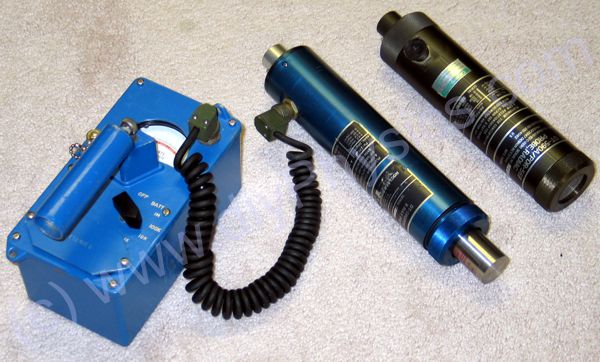
Military DT-590A/PDR-56 “x-ray” probes are widely available in the surplus market. They were meant to be used with the military Radiac Set AN/PDR-56, which is a portable scintillation-type instrument used for detection of plutonium-239 contamination. In addition to emitting 5.1 MeV alpha particles, Plutonium-239 also emits gamma rays in the energy range of 14 to 21 keV. Because these gamma rays are more penetrating than the alpha particles, they travel further in matter and air and can be detected at longer distances from the ground. The probe uses a CaF2(Eu) scintillator/photomultiplier combination to detect these 14-21 keV gammas from Pu-239. The discriminator inside the probe is factory-tuned to detect only pulses from the Pu-239 gamma rays. Hopefully you don’t have plutonium contamination in your basement, so you can set the discriminator window wide open to make the probe sensitive to a much wider range of gamma energies. In addition, you can replace the CaF2(Eu) crystal by a NaI(Tl) scintillation crystal assembly. This will turn the instrument into a general-purpose gamma radiation detector that will outperform virtually any handheld Geiger counter in the detection of 100keV to 1.3MeV photons.


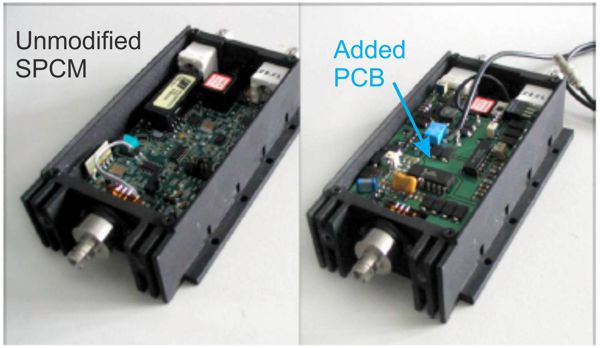 I. Rech, I. Labanca, M. Ghioni, and S. Cova of the Politecnico di Milano in Italy described an interesting modification to the Perkin Elmer SPCM-AQR Single-Photon Counting Module (SPCM) to improve its timing characteristics in:



 Our diy entangled-photon source, shown in the